
Instagram Marketing for Small Business: 15 Growth Tips
15 practical ways to grow Instagram marketing for small business, no big team needed. See how Narriva automates it. Free for 7 days.
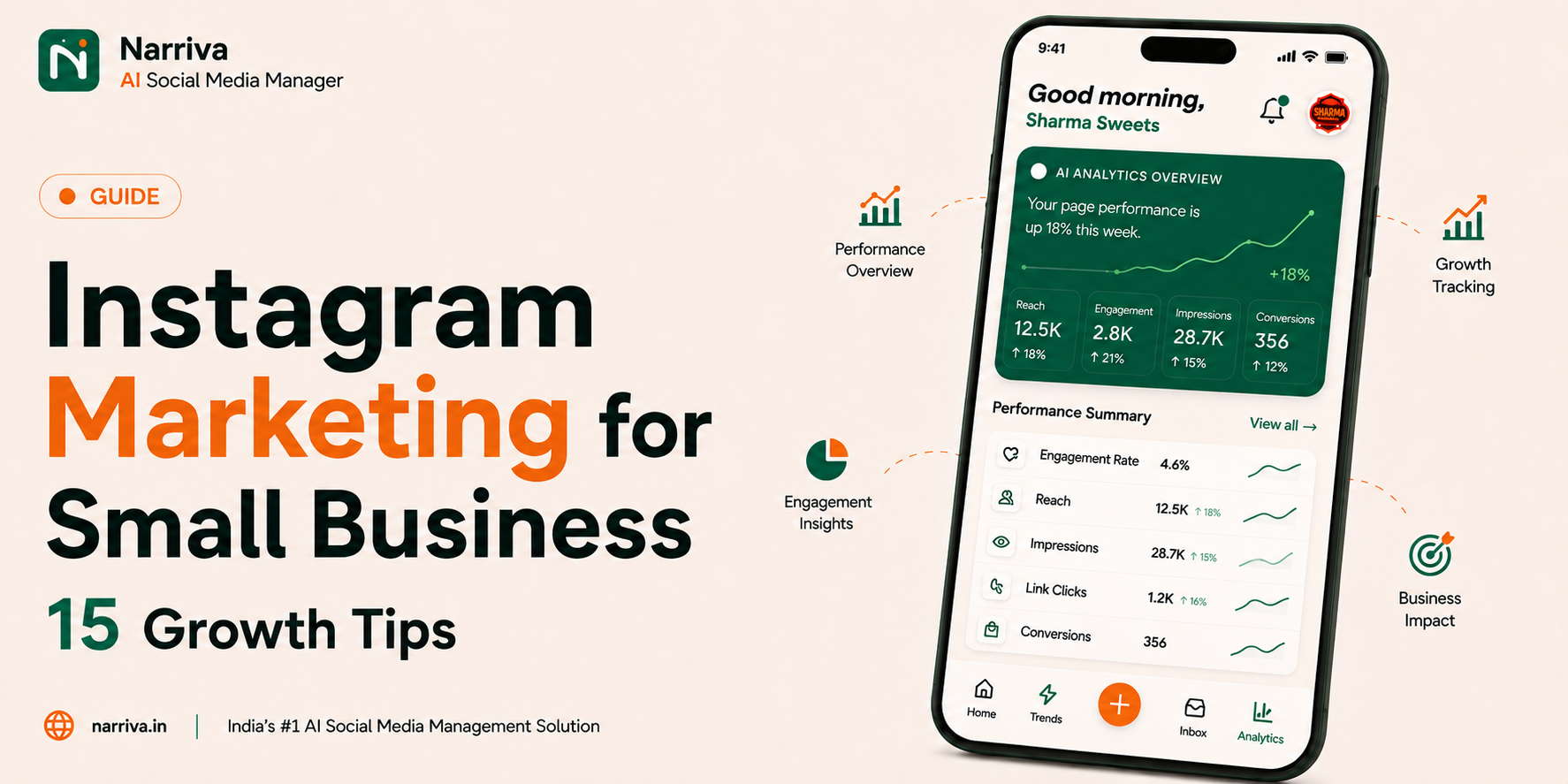
Instagram Marketing for Small Business: 15 Ways to Grow Without a Large Team
Most small business owners assume they need a marketing team to make Instagram marketing for small business actually work, a person for content, a person for design, a person for replying to DMs. In reality, you don't need a team; you need the right system, and this is exactly the gap platforms like Narriva were built to close for restaurants, cafés, boutiques and salons running their entire Instagram presence with just one or two people. This guide walks through fifteen practical ways to grow on Instagram as a small business, without hiring anyone new or spending your evenings staring at a blank caption box.
1. Post Consistently, Not Just Often
Instagram rewards consistency far more than it rewards volume. Three posts a week, every week, will outperform ten posts one week followed by silence for a month. The Instagram algorithm learns your posting rhythm and tends to favor accounts that show up predictably, because it can rely on that account to keep an audience engaged.
The fix here isn't "post more." It's building a repeatable cadence you can actually sustain, which is where a lot of small businesses quietly give up, not because they don't have ideas, but because they don't have time.
2. Use Trends, But Filter Them for Relevance
Not every trending audio or format belongs on your page. A viral meme that has nothing to do with your business just looks forced, and audiences notice. The businesses that grow fastest on Instagram don't chase every trend, they ask a sharper question: does this trend fit my niche, my audience and my brand voice? A trending "day in the life" format might work brilliantly for a café but do nothing for a real estate business, and vice versa.
3. Schedule Instagram Posts Instead of Posting in the Moment
If you're still opening Instagram every single day to post manually, you're spending time you don't need to. Learning to schedule Instagram posts in advance even just a week at a time, frees up your actual working hours for running the business. Set aside one sitting each week to plan and queue content, and let the scheduling do the rest.
4. Look for Tools That Let You Schedule Instagram Posts Free
Budget is a real constraint for most small businesses, and the good news is you don't need an expensive setup to get started. Several tools offer a way to schedule Instagram posts free, at least for a basic volume, which is often enough for a business just starting to build consistency. The move is to start free, prove to yourself that a scheduled cadence works, and then upgrade once you can see the impact on engagement and enquiries.
5. Build Content Around Your Actual Products, Not Generic Templates
A boutique with twenty products shouldn't be posting the same "shop now" graphic every week. Your catalog is content material sitting right there, new arrivals, styling ideas, behind-the-scenes of how something is made, a customer favorite restocked. Businesses that treat their own product line as a content source, instead of relying on generic templates, tend to see far stronger engagement because the content actually says something specific.
6. Reply to DMs Fast: Speed Is a Growth Lever, Not Just Customer Service
This one surprises a lot of business owners: response speed directly affects growth, not just individual sales. A customer who messages and doesn't hear back for two days often doesn't come back at all, and worse, doesn't recommend you either. Instagram also factors engagement signals into how it distributes your content, so an account with active, responsive conversations tends to get more visibility over time.
7. Sort Your DMs So Nothing Important Gets Buried
As your inbox grows, not every message deserves the same attention. A spam comment and a customer asking "do you have this in size M?" are not the same conversation, but in a busy inbox they can look identical at a glance. Separating conversations into priority leads, routine questions, and non-priority noise means your time goes where it actually matters instead of getting lost scrolling through everything equally.
8. Use AI for Social Media Posts to Solve the Blank-Page Problem
The hardest part of Instagram marketing for most small businesses isn't strategy, it's simply staring at a blank caption box with no idea what to write today. This is where ai for social media posts genuinely helps, not by replacing your voice, but by turning a trend or a product into a usable first draft you can quickly adjust and approve. The goal isn't AI writing everything blindly; it's AI removing the empty-page moment that eats the most time.
9. Keep Your Business Information Accurate and Up to Date
If you're using any kind of social media ai tool to help with captions or customer replies, the quality of what it produces depends entirely on the information you've given it, your FAQs, pricing, hours, delivery policy, tone of voice. Businesses that keep this information current get sharper, more accurate content and responses. Businesses that never update it end up with outdated or generic output and blame the tool instead of the input.
10. Study What's Actually Working, Not What You Assume Is Working
Most small business owners have a gut feeling about what performs well on their page, and that feeling is often wrong. The posts that get the most likes aren't always the ones driving actual enquiries or sales. Look at saves, shares, comments and DMs generated, not just likes, because those signals tell you what's genuinely moving people to act, not just scroll past approvingly.
11. Match Your Content Format to What Your Audience Responds To
Reels, carousels, single images and stories all perform differently depending on the business and audience. A salon might find that behind-the-scenes reels of a transformation outperform static posts, while a boutique might see carousels of new arrivals get more saves than reels. There's no universal answer here, the only way to know is to track your own performance by format and lean into what your specific audience responds to.
12. Turn Repeat Customer Questions Into Content
If customers keep asking the same question in your DMs, "do you deliver to my area," "what are your weekend timings," "is this available in another color", that's a signal for content, not just a reply template. Turning your most common questions into posts or story highlights answers them before they're even asked, and reduces the DM load on you at the same time.
13. Don't Try to Be Everywhere at Once
A common mistake among small businesses is spreading thin across Instagram, Facebook, WhatsApp and more, trying to manage each manually with the same limited time. It's usually smarter to get one channel, often Instagram running consistently and well before adding the next. A well-managed single channel outperforms three neglected ones every time.
14. Use Festivals and Local Moments, Not Just Global Trends
For Indian small businesses specifically, global trend calendars often miss what actually matters locally, Diwali, regional festivals, monsoon season, exam results season for a coaching centre, wedding season for a boutique. These local moments tend to drive far more genuine engagement than a generic global trend borrowed from an international brand's playbook, because your audience is living through them in real time.
15. Let the System Learn From Your Own Performance Over Time
The single biggest difference between a business that plateaus on Instagram and one that keeps growing is whether they're learning from their own data. A content plan built in January should look different by June, based on what's actually worked in between, not because someone guessed, but because the patterns were tracked and applied. This compounding effect is what separates steady, sustainable growth from a page that flatlines after the first few months.
What Are the Best AI Social Media Tools for Content Scheduling?
Once a small business decides to bring in a tool, the natural next question is which one to actually use. The strongest options for content scheduling do more than just queue posts, they combine trend detection, catalog-based content creation and a scheduling calendar in one place, so you're not manually feeding ideas into a separate scheduler every week. Look for a short review window before anything auto-publishes, so you stay in control without doing the manual work of posting yourself.
This is the exact space Narriva operates in, an Instagram and Facebook automation platform built specifically for Indian small businesses, combining relevant trend detection, catalog-driven content, scheduled publishing and DM handling into a single workflow, rather than a generic global scheduler with no understanding of Indian business context. For a deeper breakdown of how different platforms compare on this front, it's worth reading the comparison of the best social media tools for Indian small businesses.
Can AI Tools Help Create Social Media Captions Automatically?
Yes, and this is one of the most practical uses of AI for a small business today. A good caption tool doesn't write in a vacuum, it pulls from your actual products, your brand tone, and current relevant trends to produce a first draft that's genuinely usable, not generic filler you'd need to rewrite anyway. The keyword here is "draft," not "final." The strongest workflow is still AI generates, you review and approve, especially in the early weeks while the system is learning your voice.
For restaurant and café owners specifically wanting caption and content ideas tailored to food businesses, the Instagram growth guide for restaurants in India goes deeper into format and caption strategy for that category, and the social media marketing guide for cafés and boutiques covers similar ground for retail-focused accounts.
What Are the Most Affordable AI Tools for Social Media Content Creation?
Affordability isn't just about the sticker price, it's about what's actually included at that price. A cheap tool that only handles scheduling still leaves you manually writing captions and replying to every DM, which means you're paying for software and still doing most of the work yourself. The better comparison is total time saved per rupee spent, not just the monthly number.
Narriva's pricing reflects this directly, with plans starting at ₹1,299 a month covering a bundle of automated posts, AI-generated videos and carousels, DM auto-replies, and lead scoring, plus a 7-day free trial with no credit card required. For a small business, that's often a fraction of what a single part-time content freelancer would cost, while covering far more of the actual workload.
Building a System, Not Just a Posting Habit
The businesses that grow steadily on Instagram aren't the ones with the biggest teams, they're the ones that turned Instagram marketing into a repeatable system instead of a daily scramble. That system usually looks like: a content source that doesn't run dry (trends plus your own catalog), a scheduling habit that removes daily decision fatigue, a reply process that doesn't let customers wait, and a feedback loop that gets sharper every month instead of staying static.
For a small business trying to build exactly this kind of system without hiring anyone new, Narriva was built to handle the entire loop, trend-aware content, catalog-driven posts, scheduled publishing, DM automation and performance learning, specifically for Indian restaurants, cafés, boutiques, salons and gyms, starting at ₹1,299 a month with a 7-day free trial. You don't need a large team to grow on Instagram in 2026. You need a system that runs consistently even on the days you don't have time to think about it.
Frequently Asked Questions
- How often should a small business post on Instagram to see real growth?
Three to five times a week, done consistently, tends to outperform daily posting that isn't sustainable. The algorithm favors predictable, steady accounts over ones that post heavily for a week and then disappear.
- Can I schedule Instagram posts for free as a small business?
Yes, several tools allow you to schedule Instagram posts free at a basic volume, which is enough to build a consistent habit early on. Most small businesses eventually upgrade to a paid plan once they need higher volume, DM automation, or catalog-based content generation.
- Do I still need to write my own captions if I use AI for social media posts?
Not entirely, but reviewing is still recommended. AI tools can generate a strong first draft based on your products and brand tone, but a quick human review before posting keeps the voice accurate and avoids any mismatched or outdated information going out publicly.
- What's the biggest mistake small businesses make with Instagram marketing?
Inconsistency is the most common one, posting heavily for a short burst and then going quiet for weeks. A steady, moderate posting rhythm combined with fast DM replies consistently outperforms sporadic bursts of high-effort content.
- Is Instagram automation only useful for posting, or does it help with customer replies too?
The strongest platforms handle both. Automating just the posting side solves half the problem, the other half is responding to DMs quickly, since slow replies often cost more in lost customers than inconsistent posting ever does.